

You’re comparing two queen down comforters: one says “750 fill power,” while the other lists “38 oz fill weight.” Which one will keep you warmer? To find the best fill weight for a down comforter, compare the amount of down in inserts of the same dimensions, then read their fill power. With everything else equal, more down means more insulation. Fill power tells you how much loft each ounce can produce.
What’s the best fill weight for a down comforter?
There’s no single best fill weight in ounces for every winter comforter. If your bedroom runs cool and you wake up cold, you’ll want more insulation than someone who gets hot under a duvet cover. A king-size insert also spreads its fill over more area than a twin.
Start with two inserts of similar size and fill power. If the down and stitching are comparable, the one with more ounces of down will usually feel warmer. Different fill powers make that comparison less straightforward, so read both numbers.
Fill power vs. fill weight: which number determines warmth?
Fill power measures loft per ounce of down; fill weight measures how many ounces of filling are inside the comforter. Together, they tell you much more about potential insulation than either figure by itself. The IDFL explanation of fill-power testing describes how an ounce of down is compressed in a cylinder and measured for the space it occupies.
"Fill power is a volumetric measurement of the space a specified amount of down occupies under a specified compression weight; results can be expressed in cubic inches per ounce." - IDFL
Spec on the label |
What it measures |
What it doesn’t tell you |
|---|---|---|
Fill power, such as 650 or 800 |
Cubic inches that one ounce of down can loft under a standard test |
How many ounces of down are in the finished comforter |
Fill weight, such as 24 oz or 36 oz |
The mass of filling inside the comforter |
The weight of the entire comforter, or how lofty that filling is |
Total product weight |
Fill plus shell, stitching and other components |
How much of that weight is insulating down |
Higher-fill-power down can make a lofty layer with less fill, so a fluffy insert needn’t feel heavy. If its fill weight is low, though, that impressive fill-power number may still leave you chilly in winter.
Don’t confuse fill weight with total comforter weight
If a listing says “weight: 5 lb,” that may be the whole product, not five pounds of down. A heavier shell or cover adds heft without increasing the quantity of down inside. Look for a separate fill-weight figure in ounces or grams, and note whether the maker identifies it as down fill weight or the weight of a blended filling.
A “down and feather” fill weight may include both materials. Two inserts with the same stated filling weight can loft differently if one contains more feather. Read the composition alongside the ounces.
Compare two comforters the same size
The cleanest way to read down comforter specs is to compare identical dimensions first. The examples below are hypothetical labels, not recommended fill-weight targets or claims about products on sale.
Same-size example |
Fill power |
Down fill weight |
What you can reasonably infer |
|---|---|---|---|
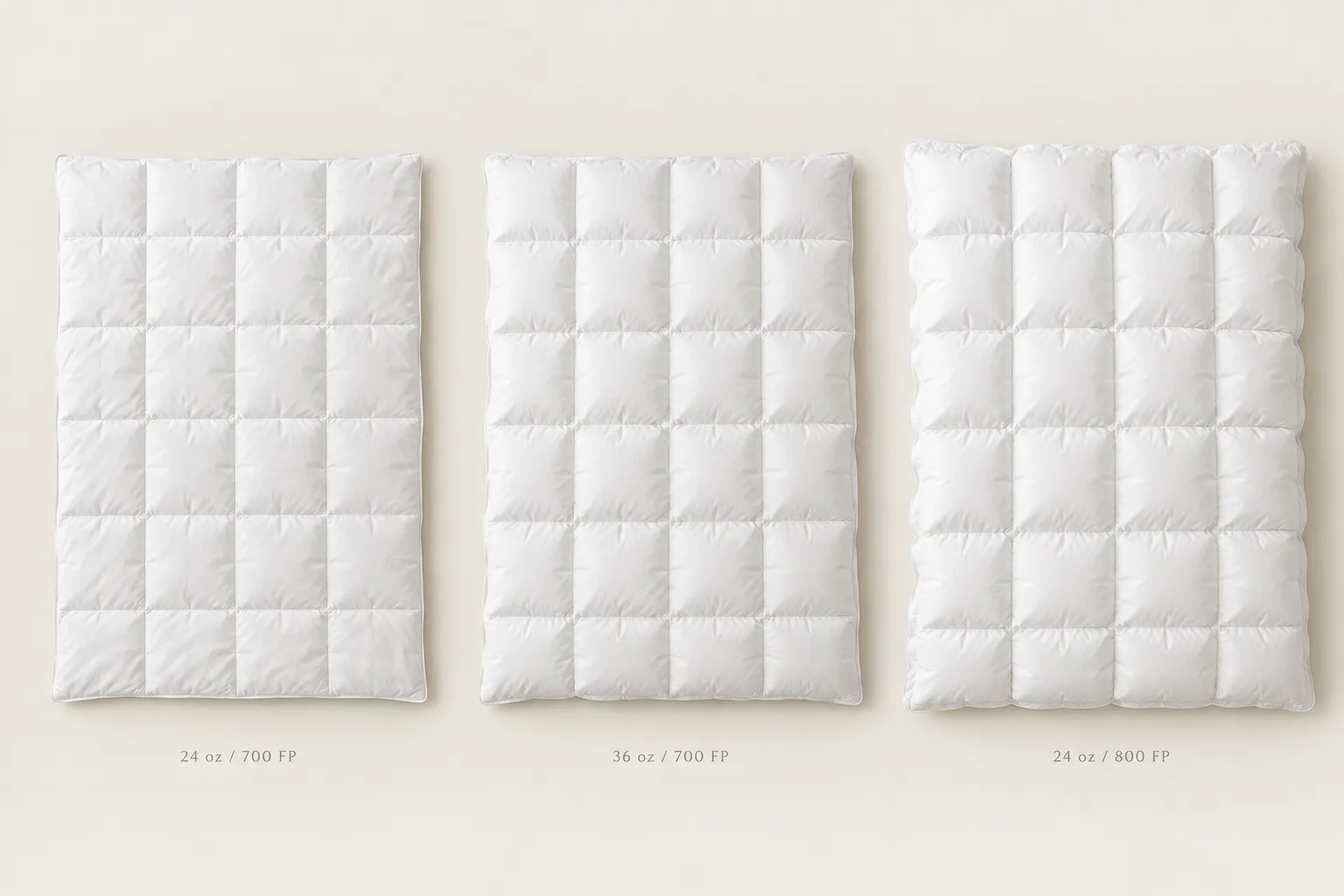
Comforter A |
700 |
24 oz |
Less down than B; likely lighter warmth if construction matches |
Comforter B |
700 |
36 oz |
50% more down than A; likely warmer if construction matches |
Comforter C |
800 |
24 oz |
More loft per ounce than A; not automatically warmer than B |
At the same 700 fill power, B has 50% more down than A, giving it more fill to insulate the bed. B versus C is harder to call. C’s down lofts more per ounce, while B contains more down, and neither label gives you an exact bedroom temperature rating.
Size can overturn an ounce-for-ounce comparison. If two inserts both contain 36 ounces but one covers a much larger bed, that down is spread thinner across the larger insert. Compare the measurements, since “queen” and “king” don’t tell you precisely how big an insert is.
You may see fill power multiplied by fill weight to estimate potential loft. For example, 700 × 36 and 800 × 24 give different theoretical volumes, but those figures are not the finished comforters’ measured volumes or warmth ratings. A test compresses loose down under controlled conditions, while stitching shapes the insert on your bed. Use the math as a rough check alongside dimensions and construction.
Why the numbers aren’t the whole warmth story
Shell fabric, stitching and your sleep setup can change how a comforter with promising specs feels. If two inserts have similar numbers, these details may help you decide.
Shell and duvet cover
The shell holds down inside the insert and affects how it drapes over you. A tight weave helps contain the fill, while a duvet cover adds another fabric layer. Cotton, linen, silk and cooling-oriented fabrics each give the bed a different feel even with the same amount of down. Keep shell weight separate from down fill weight when you compare warmth.
Baffle box or sewn-through construction
In a baffle-box comforter, fabric walls give the down room to rise inside each compartment. Sewn-through stitching pinches the top and bottom shells together at the seams. It keeps fill in place, but leaves thinner lines across the insert, which can affect how evenly those ounces of down insulate.
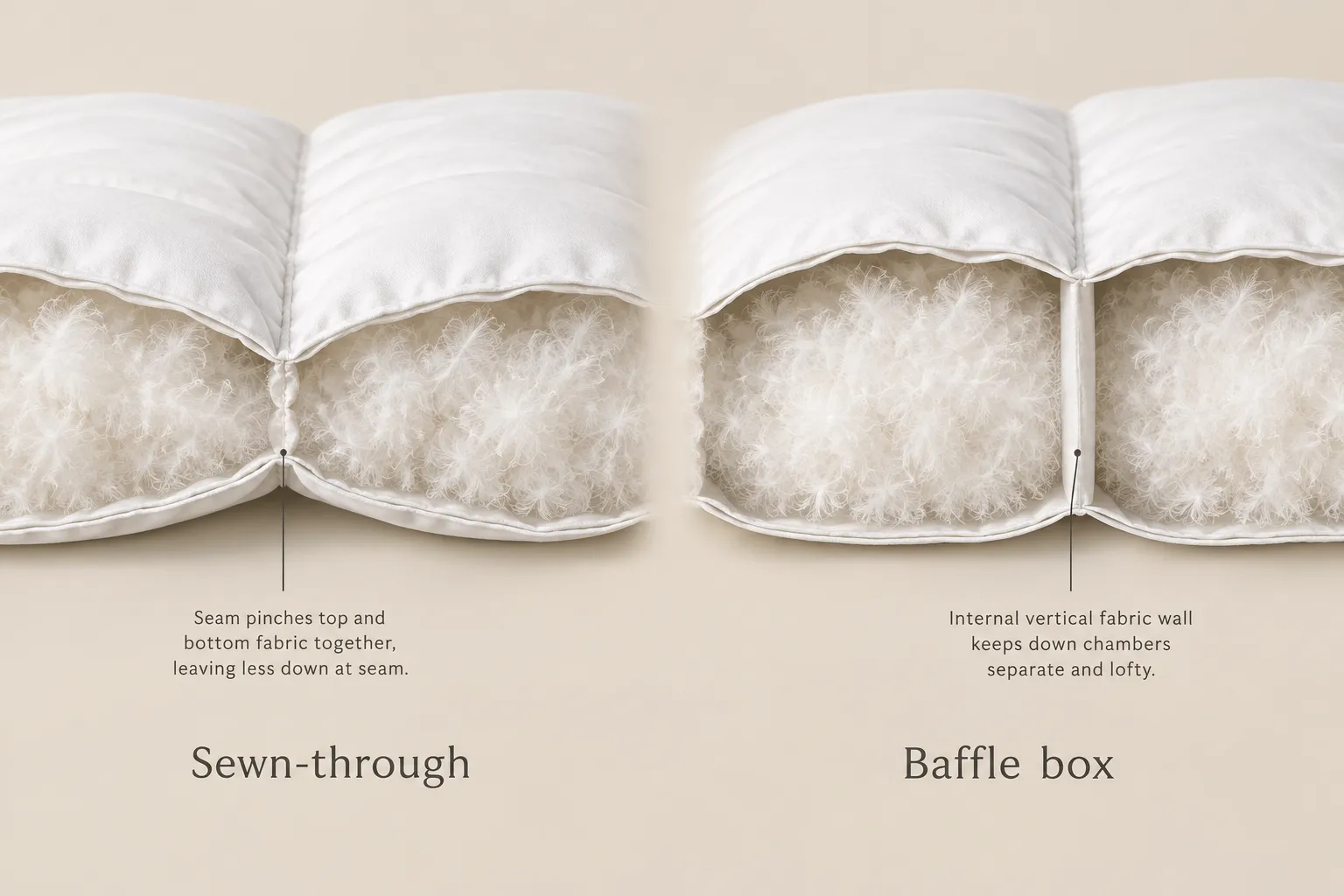
For quality markers beyond these two numbers, see Duvet Premium Down: What Makes It Worth It.
Bedroom temperature and the person under the covers
If you’re cold at night, think about the room you sleep in and the blankets you already use. A warm sleeper sharing a bed may prefer a lighter insert even in winter; their partner may want more down. Your duvet cover and sleepwear affect the result too. A “winter weight” label can’t guarantee comfort at a specific room temperature.
A comforter weight guide for a colder bedroom
For winter shopping, compare down ounces in same-size inserts before you compare loft. A big fill-power number looks impressive on a label, but you still need to know how much down you’re buying.
Match the dimensions. Compare queen with queen only when their measurements are close; otherwise, think about how widely the fill must spread.
Find the down fill weight. Distinguish ounces of down from total shipping or product weight. If a listing gives only total weight, you can’t make a sound fill-weight comparison.
Read fill power alongside it. At similar fill power, more down generally means more warmth. At similar fill weight, higher fill power generally means more loft, though construction still matters.
Look at the shell and stitching. Note the shell material, the cover you’ll use, and whether the insert has baffle boxes or sewn-through seams.
Choose for your actual nights. If you often wake chilly, favor the warmer option among otherwise comparable inserts. If you kick off the covers, don’t buy extra fill simply because the product is marketed for winter.
“800 fill power” alone won’t tell you if a comforter will keep you warm. Find its fill weight and dimensions too. A “heavyweight” label describes the maker’s intended warmth, without giving you a quantity of fill to compare.
Make the choice that fits your bed
Choose enough down for the insert’s size and enough loft for that amount of down. A generously filled 700-fill-power insert could suit your winter bed better than a thinly filled 800-fill-power one. Explore Warmy & Tummy’s down comforters to compare the shell and warmth options alongside the filling, especially if a season label alone doesn’t describe how you sleep.
FAQ
What is the most fluffy down comforter?
A comforter with lofty down, enough fill for its dimensions and room for that down to expand will look fluffy. Higher fill power increases loft per ounce, while baffle-box construction gives the fill space to rise; the number alone can’t identify the fluffiest finished comforter.
How much does a comforter usually weigh?
There’s no useful single weight for all comforters: dimensions, fill amount and shell material vary. If you mean down fill weight, look for its ounces or grams on the label; a total product weight also includes the shell and stitching.