

Shopping for duvet covers twin beds can use, only to find “Twin” and “Twin XL” on the same shelf? Measure the insert you plan to use. Your cover should be close to its width and length, with enough bedding left to drape over the mattress.
A cover is the removable outer layer. The warm filling comes separately, a detail that's easy to miss when you shop by the photo.
What size are duvet covers twin beds need?
A twin duvet cover commonly measures about 64 to 71 inches wide and 86 to 91 inches long. Sizes vary by brand, so use the printed width and length to see whether your insert will fit.
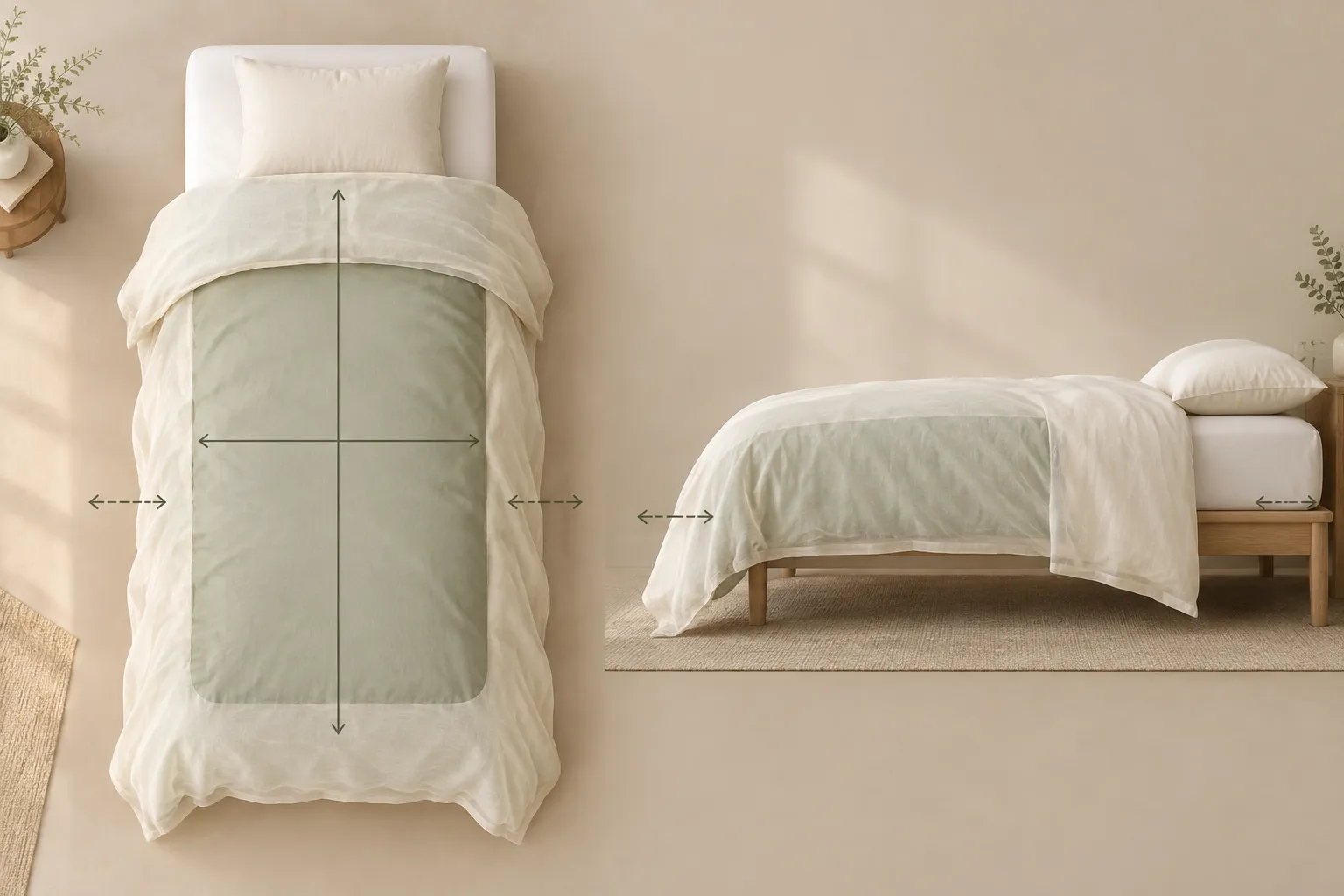
A multi-brand bedding-size chart puts Twin and Twin XL covers in overlapping ranges. A cover marked “Twin/Twin XL” may suit either bed, provided it fits your insert.
Item |
Example dimensions, width × length |
What to do with the number |
|---|---|---|
Twin duvet cover |
64–71 × 86–91 in. |
Compare with the insert, not just the bed label |
Twin XL duvet cover |
64–71 × 86–90 in. |
Check its actual length; labels overlap |
Twin comforter |
About 68–70 × 86–88 in. |
Can be used on its own or, if compatible, inside a cover |
Twin XL comforter |
About 68 × 90–92 in. |
Look for a cover long enough to house it |
The cover ranges come from a multi-brand bedding chart, and the comforter examples come from one manufacturer's guide. They're examples rather than fixed sizes. If the comforter is longer than the cover, the Twin XL label on both won't help.
Twin vs Twin XL: which cover fits?
Start with your insert's length. A twin cover can work on a Twin XL bed if it holds the insert and gives you enough coverage at the foot. On a standard twin bed, a longer Twin XL setup may leave extra fabric there.
"A twin mattress is 38 × 75 inches; a twin XL is 38 × 80 inches, the same width with 5 extra inches of length." - Sleep Foundation
Twin XL doesn't always mean a longer cover. Some brands use a shared Twin/Twin XL cover size; others offer separate measurements. If your insert is 90 inches long, skip an 86-inch cover and look for one close to 90 inches.
How to measure before you order
Lay the insert flat and measure its width and length. Compare those figures with the cover's finished dimensions. Too much extra cover fabric leaves empty corners; too little bunches the filling.
Measure the insert's width and length in inches, even if its tag says Twin.
Compare both dimensions with the cover. An extra inch or two in cover length can work, unless the product's fit instructions say otherwise.
To estimate the hang on each side, subtract the mattress width from the bedding width and divide by two. Remember the mattress depth if you'd like the duvet to cover its sides.
Say your insert measures 68 × 90 inches. Look for a cover close to 68 × 90 inches, since an 86-inch cover will be too short. If you want more fabric hanging over the bed, buy a larger insert and matching cover together; a bigger cover alone only adds empty fabric.
Duvet cover vs comforter: what are you actually buying?
A duvet cover is a washable fabric shell for an insert. A comforter already contains the filling, so you can use it on its own or slip it into a cover if the sizes and attachment points work together.
You can wash a cover or change its color without laundering the insert each time. Look for a button closure, zipper or ties; corner ties inside the cover help hold the insert in place. With a stand-alone comforter, you'll handle the whole filled piece when you wash it or change the look of the bed.
Choose the filled layer's warmth separately from the cover fabric. Your cover affects the feel against your skin and the look of the bed; the insert or comforter provides most of the loft and insulation.
Need help with the filled layer? Start with how to choose a comforter warmth level, then look at the difference between a duvet insert and a down comforter.
Which twin duvet cover fabric should you choose?
Choose fabric by feel and care needs. If you plan to wash your cover often, a fussy care label can matter more than the color.
Fabric |
Feel and appeal |
Trade-off to consider |
|---|---|---|
Cotton |
Familiar, breathable feel for everyday use |
Texture varies by weave; read the care label |
Linen |
Relaxed texture and airy feel |
Wrinkles are part of the look |
Silk |
Smooth, lustrous finish |
Often calls for more delicate care |
Tencel-blend or other cooling fabric |
Smooth feel that may appeal to warm sleepers |
Blend composition and care vary by product |
An easy-care cotton cover makes sense on a child's bed or in a dorm, where laundry piles up. Linen looks good with its wrinkles. Silk and cooling blends vary, so the fiber content and wash instructions deserve a closer look.
Among cotton duvet covers, percale usually feels crisp, while sateen feels smoother. A linen duvet cover can suit you if you like texture. “Machine washable” is worth looking for on any label, especially for a dorm bed; the care instructions for a silk or blended cover may differ.
Curious about cotton? You can read more about the feel and care of organic cotton duvet covers.
What comes in twin duvet sets?
A twin duvet set may include a cover and a matching pillow sham, but a duvet insert is not automatically included. Duvet cover sets group pieces for sale; they don't necessarily include the filled layer or sheets.
Read the “what's included” line: note the number and size of the shams, and look for “cover only,” “cover and sham,” or “insert included.” Sheets are separate. Casper's sheet-size chart lists different fitted-sheet lengths for Twin and Twin XL, even when one duvet cover suits both beds.
A quick fit checklist before checkout
Match a cover to the insert you already own, or choose both pieces together. Before checkout, keep these details beside the product listing:
Insert width and length, plus cover width and length.
Bed coverage you want, including room for mattress depth and foot drape.
Included pieces, interior ties, closure and fabric care.
If you're starting from scratch, Warmy & Tummy offers premium comforters with different shells and warmth choices alongside duvet covers. Pick the comforter you want to sleep under, then use its stated dimensions to choose a cover. That way, the print you love won't leave you with empty corners.