

Kicking off the covers at 2 a.m., then pulling them back on when the AC starts? A summer comforter for a California king can work if it's lightly filled, has a breathable surface and reaches past the foot of the mattress. You can keep that comforter feel in summer. The word “cooling” on the label won't tell you enough on its own.
How to choose a summer comforter California king sleepers won't kick off
Think about your bedroom at night. With AC and a preference for a little loft, you might be happy with a light down or down-alternative insert in an airy shell. In a humid room, or if you wake up sweaty, go thinner and pay attention to moisture handling. If even that sounds too warm, a quilt or light blanket may feel better.
Measure your mattress, then read the comforter's stated width and length. A California king is longer and narrower than a standard king, so a king/cal king label doesn't guarantee the drape you want.
What makes a comforter suitable for hot weather?
A summer comforter should give you coverage without the trapped warmth of a thick winter one. The fill, shell and cover all affect how it feels overnight.
Heat can interfere with sleep long after you've drifted off. Researchers studying nighttime temperatures projected this loss as temperatures rise:
"By 2099, suboptimal temperatures may erode 50–58 hours of sleep per person per year." - Minor et al., One Earth
Fill weight matters more than puffiness
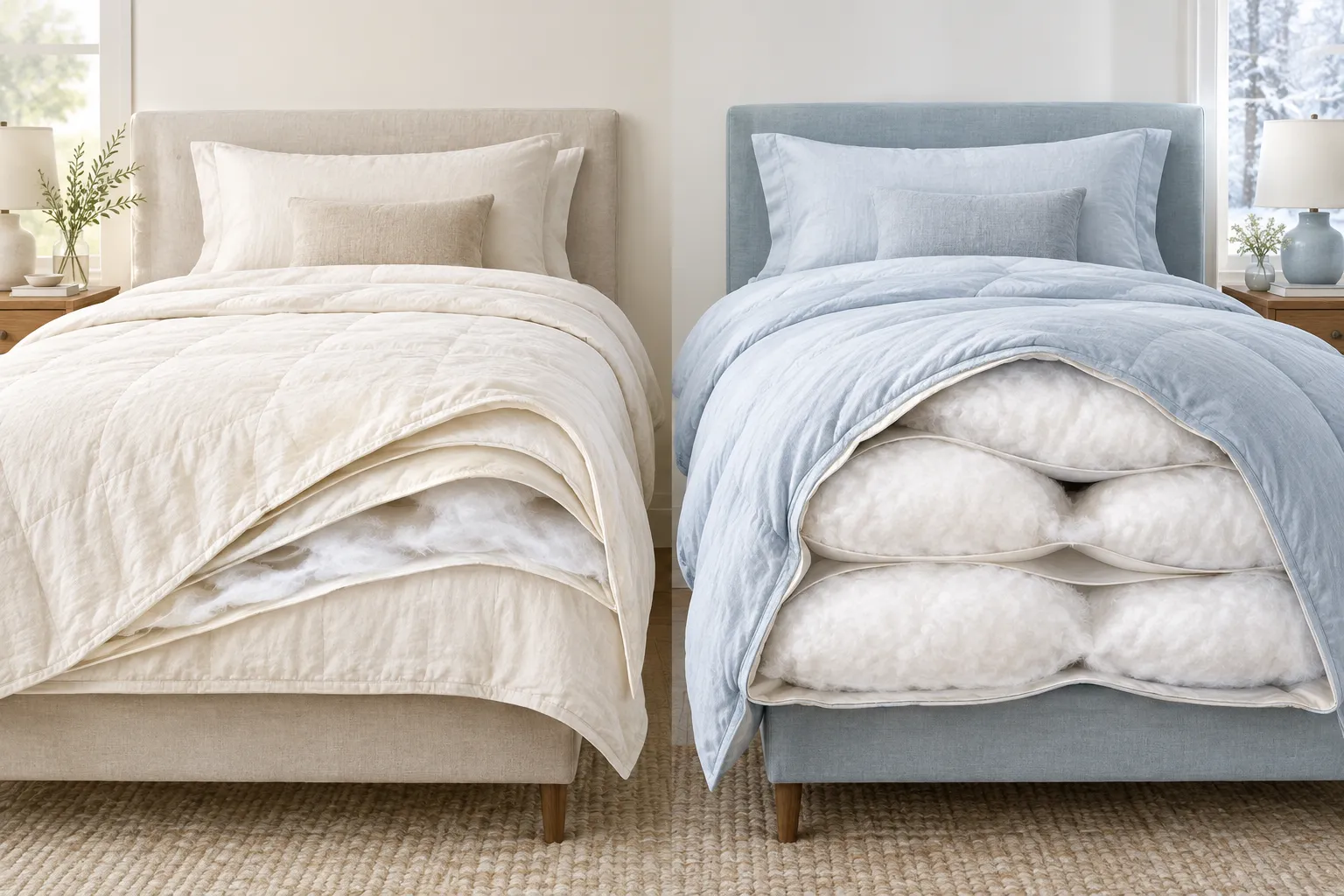
“Summer,” “lightweight” and “ultra-lightweight” are a starting point. If the listing gives a fill weight, use it: total weight includes the shell as well, so the two numbers mean different things. GSM means grams per square meter, though you'll need to know if it describes the fill, fabric or finished comforter. The comforter warmth-level guide can help you narrow down the feel you want.
Lightweight down gives you loft without much bulk. A densely filled down alternative can feel warmer despite looking flatter. Fill power describes down's loft, not how much insulation the comforter contains. And “feather fiber comforter” might mean synthetic fill rather than goose down. Read the materials label, then weigh the shell and fill together instead of trusting one number.
The shell and cover can change the whole feel
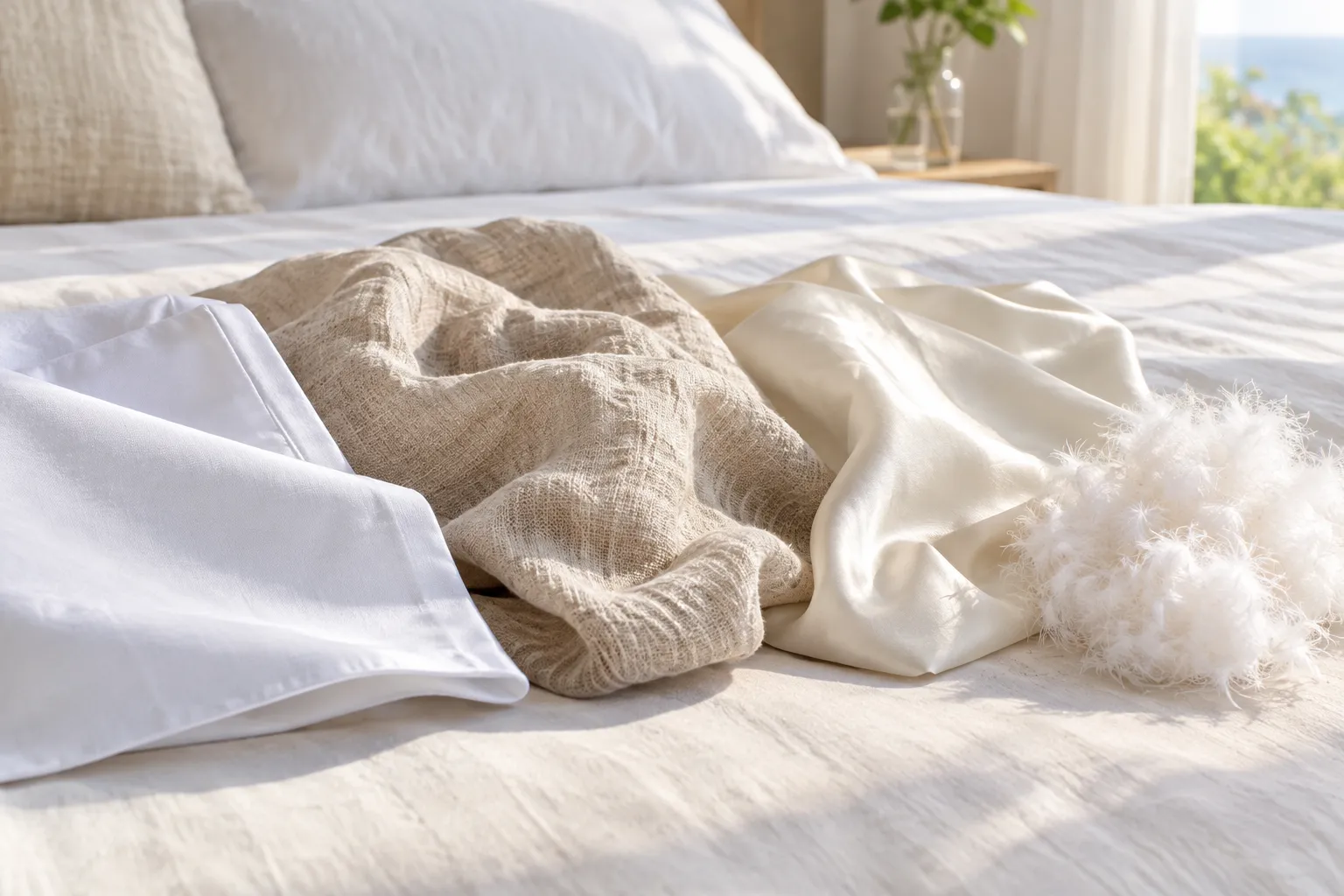
The shell wraps around the fill, and you can feel the difference: cotton percale is crisp, silk or lyocell blends are smoother, and linen has texture. A coated or dense fabric might feel different once you've slept under it for hours, even if the label says “cooling.”
Thread count tells you something about the fabric, but it isn't a cooling score. The weave and the weight of the layers above you deserve more attention.
Your summer comforter cover counts as another layer. A bulky duvet cover adds warmth, while breathable cotton or linen keeps the setup lighter. Match the cover's dimensions to the insert so the fill doesn't bunch inside it. For help choosing the fabric, use the duvet-cover selection guide.
Moisture management counts on muggy nights
Cool-to-the-touch fabric feels refreshing when you climb into bed. Later, if you perspire, a fabric that moves moisture away from your skin and dries can feel less clammy. In a humid room, an airy shell and lightly packed fill will serve you better than a cool first touch over a heavy insert.
Which summer comforter materials feel coolest?
Like a crisp bed? Start with cotton percale. Silk or lyocell-based fabric drapes more smoothly, while linen has more texture. The fill and its weight will still do much of the work when it comes to warmth.
Material or construction |
What it feels like |
Best fit in summer |
Tradeoff |
|---|---|---|---|
Cotton percale shell with light fill |
Crisp and familiar |
Sleepers who want an airy, classic bed |
Cotton can feel damp if heavy layers slow drying |
Linen shell with light fill |
Textured and relaxed |
People who dislike a slick surface |
Its texture and wrinkles aren't for everyone |
Silk or lyocell-blend shell with light fill |
Smooth and drapey |
Sleepers who prefer a softer surface |
A smooth touch doesn't make a heavy fill cool |
Lightweight down |
Lofty without a dense feel |
People who still want a puffy comforter |
Too much fill can trap heat |
Lightweight down alternative |
Varies by fill and shell |
People seeking a non-down option |
“Down alternative” alone says little about warmth |
Summer weight cotton comforter |
Flatter, less puffy |
People who value easy layering |
May not give you the cloudlike look of down |
There's no single coolest fiber for everyone. A thin fill in a breathable shell is a better clue than the fiber name alone.
California king summer comforter sizing and overhang
A California king mattress measures 72 by 84 inches; a standard king size bed measures 76 by 80 inches. A regular king comforter may hang nicely at the sides but fall short at the foot.
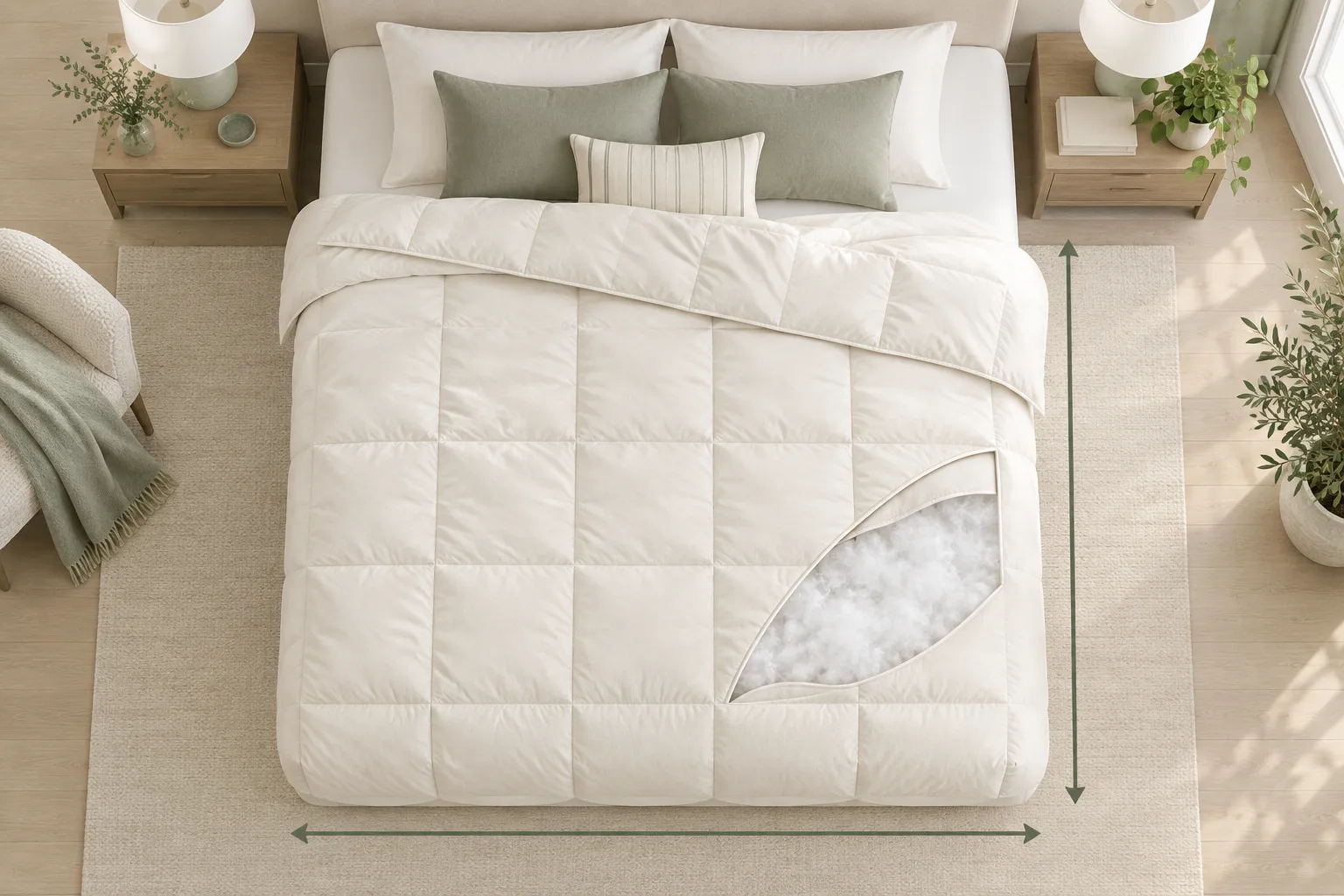
To work out the width, add your mattress width and the drop you want on each side. Say you want 16 inches hanging off either side of a 72-inch-wide California king: you'll need at least 104 inches (72 + 16 + 16). For length, add the foot drop to the mattress's 84 inches, then think about how far you pull the comforter toward the head of the bed. A 12-inch foot drop alone takes at least 96 inches of length.
Your bed |
Mattress size |
What to measure on a comforter |
|---|---|---|
Queen |
60 × 80 inches |
Width for side drape and length for foot coverage |
Standard king |
76 × 80 inches |
Enough width for both sleepers without unnecessary extra fabric |
California king |
72 × 84 inches |
Length first, then width for your preferred side drop |
Sizes vary, even among summer comforters sold as queen or king. Full/queen size might be one shared size, and “cal king size” or “California king size” still calls for a look at the dimensions. If the “king/cal king” comforter is reversible, turn it to see which way gives you the length you need. Match the cover to that orientation, if you're using one. An oversized king may give you width without enough length.
Comforter, set, cover or lighter layer?
A summer comforter gives you loft and a made-bed look without winter-weight insulation. If you're still hot under a light insert, or you'd rather skip the puffiness, try a flatter layer.
Option |
When it makes sense |
Watch for |
|---|---|---|
Standalone summer comforter |
You want control over shell, fill and cover |
An added cover can change the feel |
Summer comforter set |
You want matching shams and an easy room refresh |
The set's listed size and pieces may not match your needs |
Quilt or coverlet |
You prefer a flatter, easy-to-fold layer |
Less lofty comforter feel |
Light blanket plus sheet |
You want the easiest way to adjust coverage |
A different look from a finished comforter |
A matching bedding set makes the room look pulled together. It doesn't tell you what the comforter is filled with, though. If you're browsing summer comforter sets queen listings, read the fill and shell details before choosing a solid color or matching pillow shams. A duvet cover set may include a cover and shams but no filled duvet insert. For a California king summer comforter set, the comforter's measurements matter more than the size of the shams.
Put together a bed that sleeps as cool as it looks
You can make the bed look full without sleeping under every layer. Try breathable sheets and one summer-weight comforter, adding a cover if you like. If your partner sleeps cooler, separate layers let each of you adjust without wrestling over one warmer comforter.
Care and the details on the tag
If two comforters look equally good, care instructions may decide it for you. For easy laundering, look for a machine washable option and read the whole tag: “machine wash cold,” “gentle cycle” and “tumble dry low heat” call for a different routine from dry cleaning. The directions for down, silk and synthetic fiber fill aren't interchangeable.
The fitted sheet and cover affect airflow, too. Pile a thick faux fur throw on top and the bedding experience changes: it looks cozy, but you'll sleep under more warmth.
Warmy & Tummy offers goose down comforters with cotton, silk, linen and cooling-focused shell choices, plus a mix-and-match option. If you love down's loft, you can tailor the feel for summer. Down won't suit everyone, and a breathable shell can't make too-warm fill comfortable in a hot room. Choose the warmth level and dimensions first, then the finish you like. For more on down, see how a down comforter works in summer.
Measure your California king's foot coverage before you shop. With those numbers handy, you can browse Warmy & Tummy's material and warmth options for a light, breathable comforter that gives you more than a sheet.
FAQ
What is the best comforter for hot summers?
A lightweight comforter with a breathable shell and low fill quantity is a good starting point. If your room stays humid, consider moisture management as well as warmth; if a light comforter still feels too hot, use a quilt or sheet instead.
Which comforter is best for summer?
Choose one rated lightweight or summer weight with a shell you like against your bedding, such as cotton percale, linen or a smooth lyocell blend. Compare the fill specifications and the actual dimensions before deciding.
What is the best comforter for a California king size?
The best fit is a comforter whose measured length covers your 84-inch mattress and gives you the foot drop you want. Check its width against your preferred side drop too; a king/cal king label alone isn't enough.
Is there such a thing as a California King comforter?
Yes, comforters are sold for California king beds, and some are labeled king/cal king. Since dimensions vary by product, compare the stated width and length with your mattress and preferred overhang.
Is an oversized king comforter the same as a California king comforter?
Not necessarily. An oversized king may give you more width without enough length for a California king mattress. Compare both dimensions rather than relying on the size name.