
Duvet for Summer: Best Covers for Cool Sleep
Warm nights should feel restful, not sticky, heavy, or frustrating. If you’ve ever kicked off your bedding at 2 a.m., flipped the pillow for the cool side, or argued over bedroom temperature with your partner, choosing the right duvet for summer can make an immediate difference.
The secret is not simply using “less bedding.” It’s using better layers: a lightweight insert, breathable shell, and duvet covers for summer that allow heat and moisture to escape instead of trapping them around your body. At Warmy & Tummy, we believe cool sleep should still feel cozy, elevated, and beautifully styled - never clinical or flimsy.
"The recommended bedroom temperature for sleep is between 60°F and 67°F (15.5°C to 19.4°C)." - Sleep.com
"Night sweats, or being a 'hot sleeper,' can affect anywhere from 10% to 41% of individuals." - Healthline

What makes a summer duvet actually work?
A true warm-weather duvet should do three things well:
Feel light on the body
Promote airflow
Manage moisture without feeling damp
Many people focus only on thickness, but summer comfort is more nuanced than that. A duvet can be thin and still sleep hot if the fabric is dense, synthetic, or poorly ventilated. On the other hand, a thoughtfully made lightweight duvet with a breathable cover can feel cool, dry, and soothing all night.
The best summer duvet balance: light, breathable, and softly insulating
Even in summer, most sleepers still want some gentle drape and comfort. That’s why the best options aren’t usually “no duvet at all.” They’re lightweight constructions that offer just enough coverage to feel secure without overheating.
At Warmy & Tummy, this is where premium materials matter. Shell fabric, fill type, stitching, and even how you layer your bed can dramatically change sleep quality.
Signs your current duvet is too warm for summer
If your bed looks beautiful but your sleep feels restless, your bedding may be the issue. Common signs include:
Waking up sweaty in the middle of the night
Throwing one leg out from under the covers for relief
Feeling clammy rather than comfortably warm
Needing to remove the duvet completely by morning
Sleeping well in winter but poorly in late spring and summer
A seasonal switch often solves this faster than changing your mattress or lowering the thermostat.
Summer duvet vs winter duvet: what’s the real difference?
The difference is not just “less fill.” It’s the whole sleep system.
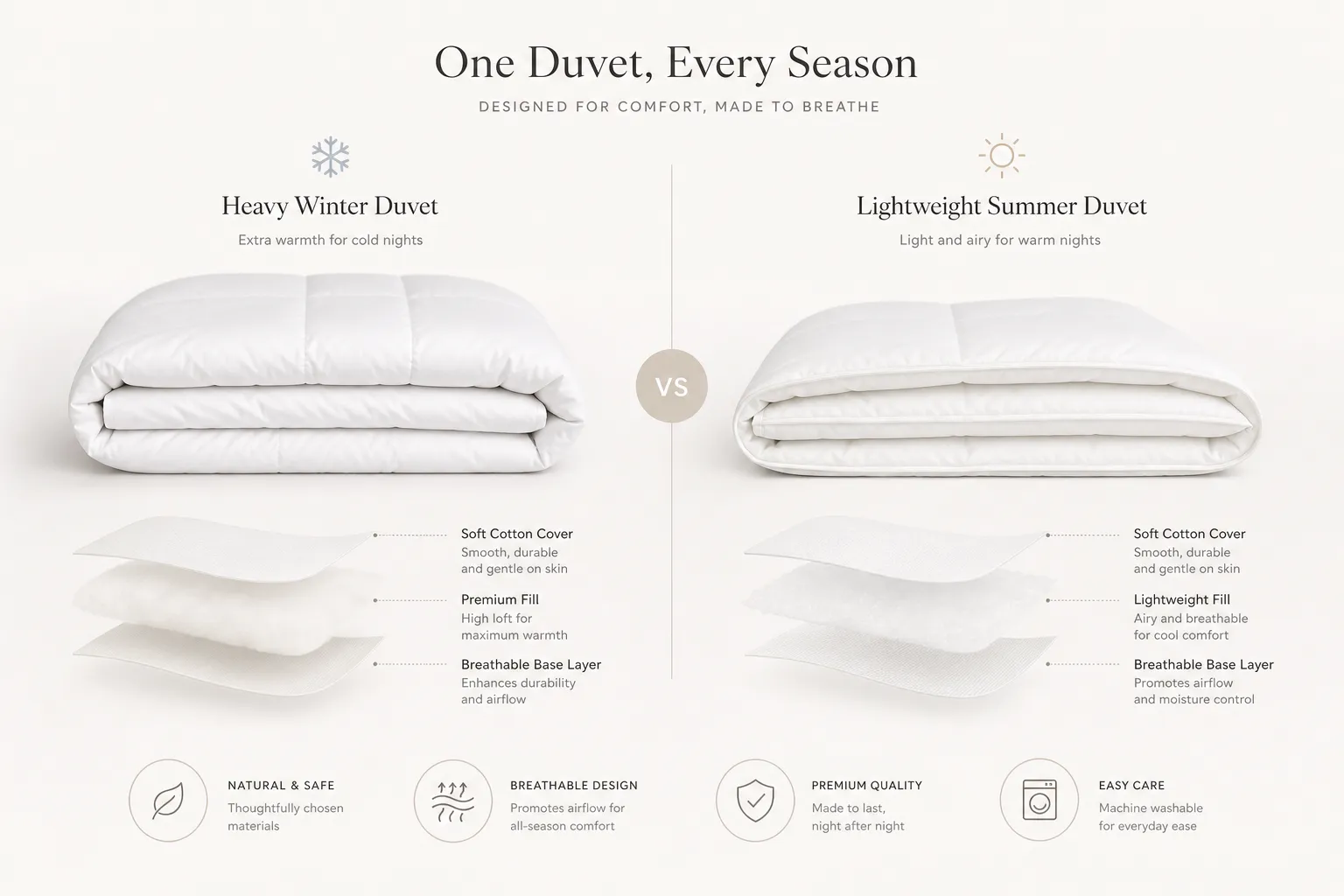
Feature |
Summer Duvet |
Winter Duvet |
|---|---|---|
Loft |
Low to medium |
Medium to high |
Warmth level |
Light |
Warm to extra warm |
Breathability |
Priority feature |
Important, but secondary to insulation |
Moisture control |
Essential |
Helpful |
Ideal shell fabrics |
Linen, cotton, silk, lyocell, cooling blends |
Cotton, sateen, silk, denser weaves |
Best for |
Hot sleepers, warm climates, layered beds |
Cold sleepers, winter months, drafty rooms |
Why covers matter just as much as inserts
This is one of the biggest gaps in most bedding advice: people shop carefully for the insert, then put it inside a heat-trapping cover.
Duvet covers for summer should be breathable, quick-drying, and soft against skin. A cooling insert inside a heavy, less breathable cover can still sleep too warm. Think of the cover as the climate-control layer you actually feel.
Best materials for a duvet for summer
Material choice is where summer bedding goes from average to transformative.
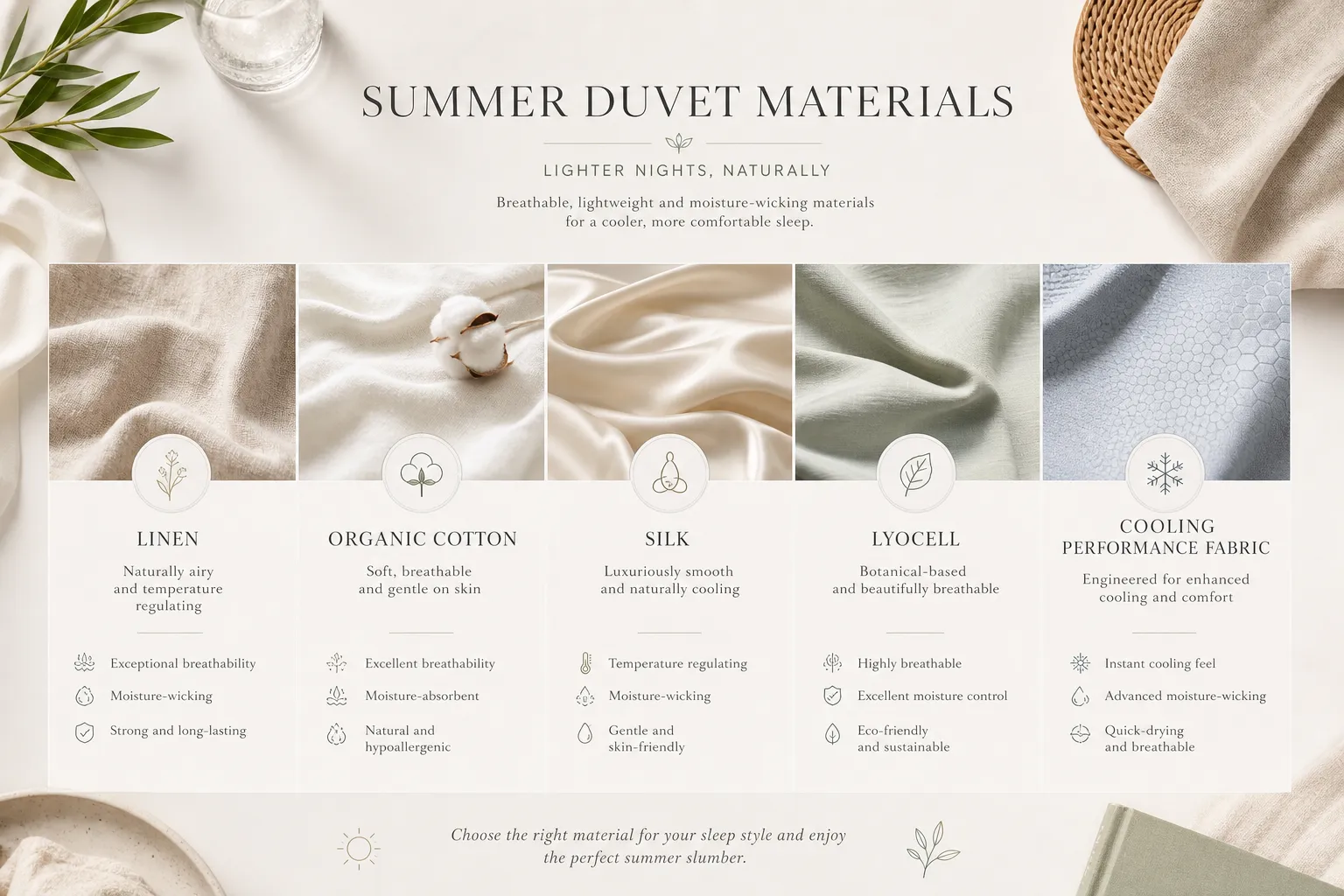
Linen
Linen is one of the most beloved summer bedding materials for good reason. It feels airy, relaxed, and naturally breathable. It also has a lived-in elegance that suits luxury bedrooms beautifully.
Best for: warm climates, casual-luxury styling, sleepers who like texture
Feel: crisp at first, then softer over time
Organic cotton
Organic cotton is a classic choice for breathable comfort. In a percale weave especially, it feels cool, fresh, and clean without being slippery.
Best for: households wanting an easy-care, versatile fabric
Feel: smooth, light, familiar, breathable
Silk
Silk offers a refined temperature-regulating feel that works surprisingly well in summer. It’s lightweight, naturally elegant, and soft against sensitive skin and hair.
Best for: luxury shoppers, sensitive sleepers, elevated bedroom aesthetics
Feel: smooth, fluid, airy, premium
Lyocell and Tencel blends
Lyocell-based fabrics are loved by many hot sleepers because they tend to feel cool, silky, and moisture-managing. They’re especially useful for those who overheat but still want a soft drape rather than a crisp hotel-sheet feel.
Best for: hot sleepers, modern bedding preferences, smooth cooling comfort
Feel: sleek, cool, soft, fluid
Cooling performance fabrics
Some advanced bedding fabrics are engineered specifically for heat release and moisture control. These can be especially helpful for very warm sleepers, couples with different temperature needs, or humid environments.
Best for: chronic hot sleepers, summer heat, high-performance sleep setups
Feel: cool-touch, lightweight, technical yet comfortable
The best duvet covers for summer by sleeper type
Choosing the right duvet cover becomes much easier when you match it to how you sleep.
For hot sleepers: linen or lyocell blends
If you radiate heat at night, prioritize maximum airflow and moisture management. Linen and lyocell blends are often the sweet spot.
For couples with different temperature needs: lightweight cotton or cooling performance fabric
These options help regulate the bed microclimate without feeling too cold for the partner who runs chillier.
For sensitive skin: silk or organic cotton
These fabrics tend to feel gentle, breathable, and less irritating than rougher or heat-retaining materials.
For a polished luxury look: European linen or deluxe silk
These offer a high-end finish while still supporting cooler, lighter sleep in warm weather.
Fill matters too: what should be inside a summer duvet?
People often focus on the outer shell, but the fill affects loft, drape, and warmth.
Goose down in a lightweight fill power
Premium goose down is not automatically “too hot.” In the right summer weight, it can be airy, lofty, and highly breathable. The key is choosing a light warmth level, not a winter-grade fill.
Silk fill
Silk-filled duvets are often loved for summer because they feel light, smooth, and naturally temperature regulating.
Wool for year-round balance
Merino wool can work beautifully for sleepers who want a naturally breathable insert that adapts across seasons.
Cooling alternative fills
Performance fills designed for airflow and moisture release are excellent for hot sleepers who prefer down-alternative options.
How to choose the right summer duvet weight
A simple way to decide:
Sleeper or Climate Need |
Best Choice |
|---|---|
Very hot sleeper |
Ultra-lightweight insert + breathable cooling cover |
Average sleeper in summer |
Lightweight insert + linen or cotton percale cover |
Cool sleeper in air conditioning |
Light-to-medium insert + breathable cotton or silk cover |
Couple with mixed preferences |
Lightweight core + temperature-balancing cover fabric |
Don’t forget your room conditions
Your ideal choice depends on more than your body temperature:
Do you sleep with strong air conditioning?
Is your climate humid or dry?
Do you live in a city apartment that retains heat?
Does your partner sleep colder than you do?
This is where a mix-and-match approach becomes valuable. Warmy & Tummy makes it easier to tailor warmth level, shell material, and overall feel so your bed works for your real life - not a generic average sleeper.
Common mistakes people make with summer bedding
Choosing the lightest option without considering feel
Some ultra-thin bedding feels unsatisfying and gets kicked aside. The goal is cool comfort, not bare exposure.
Using a dense duvet cover
A summer-friendly insert can underperform if paired with the wrong cover.
Ignoring weave
Percale usually feels cooler and crisper than sateen. That subtle difference matters in warm weather.
Keeping winter layers on the bed
Even decorative layers can trap heat. In summer, a cleaner, lighter bed build often sleeps better.
The ideal summer bedding setup
For most households, the best setup looks like this:
Lightweight summer duvet insert
Breathable duvet cover in linen, organic cotton percale, silk, or cooling lyocell blend
Light fitted sheet in a breathable fabric
Minimal extra layers at the foot of the bed
Optional lightweight blanket for changing temperatures

What premium shoppers should look for
If you’re investing in better sleep, don’t just compare prices. Compare construction, material quality, and flexibility.
Look for:
Natural or advanced cooling fabrics
Season-specific warmth levels
Breathable shell construction
Beautiful design that works with your bedroom
Easy-care and durable craftsmanship
Fair returns and strong customer support
At Warmy & Tummy, we build bedding for people who want more than a basic blanket. Our collections are designed for deeper, more restorative sleep with premium materials like organic cotton, silk, linen, goose down, merino wool, and cooling fabrics - plus the freedom to personalize your comfort level through thoughtful mix-and-match options.
Why Warmy & Tummy is a smart choice for summer sleep
A great summer bed should feel effortless: cool, beautiful, and truly comfortable night after night.
Warmy & Tummy brings together the details that matter most:
Premium bedding designed for deeper, more restful sleep
A wide range of comforters for different seasons and warmth preferences
High-quality materials including organic cotton, silk, linen, goose down, merino wool, and cooling fabrics
Customizable mix-and-match comforter options
Eco-friendly and sustainable choices
Stylish luxury designs and limited-edition collections
30-day hassle-free returns and money-back peace of mind
Fast customer service via email and chat
Free shipping in the USA on qualifying orders
Backed by more than 20 years of bedding experience and a 3-year limited warranty
That combination is especially helpful for summer bedding, where personal preference matters so much. One person wants airy linen, another wants silky cooling fabric, and another wants lightweight goose down with a breathable organic cotton shell. The best brand is the one that lets you create your version of cool sleep - without sacrificing quality or style.
Final verdict: what is the best duvet for summer?
The best duvet for summer is one that feels light, breathable, and moisture-aware, paired with a cover that helps your body release heat instead of holding it in. For many sleepers, that means a lightweight insert with a linen, organic cotton percale, silk, or cooling lyocell-blend cover.
If you want a bedroom that feels both luxurious and seasonally smart, Warmy & Tummy offers the rare combination of craftsmanship, customization, cooling materials, and reassuring service. It’s an easy upgrade with a real effect on how you sleep tonight - and all summer long.
FAQ
What is the best duvet for cool sleep?
The best option is usually a lightweight duvet made with breathable materials and a season-appropriate fill. For most hot sleepers, a summer-weight insert paired with a linen, organic cotton, silk, or cooling-performance cover creates the most comfortable balance.
What is the best duvet cover for hot summer?
A breathable duvet cover in linen, cotton percale, or a cooling lyocell blend is often ideal for hot summer nights. These fabrics help air circulate and reduce the trapped heat that can make sleep feel sticky or restless.
What is the coolest fabric for a duvet cover?
Linen and cooling lyocell-based fabrics are among the coolest-feeling choices for many sleepers. Linen excels at airflow, while lyocell blends often feel smoother and cooler to the touch with excellent moisture management.
Which duvet cover is best for summer?
The best summer duvet cover depends on your sleep style, but linen, organic cotton percale, silk, and cooling-performance fabrics are strong choices. The right one should feel light, breathable, and comfortable against bare skin.
Should hot sleepers use a duvet cover?
Yes, hot sleepers can absolutely use a duvet cover if they choose a cooling, breathable fabric. A good cover protects the insert, improves comfort, and can actually help sleep cooler when paired with the right lightweight duvet.
What is the most breathable cooling duvet cover?
The most breathable options are typically linen and cotton percale, while some sleepers prefer advanced cooling fabrics or lyocell blends for added smoothness and moisture control. The best pick depends on whether you value crisp airflow, silky softness, or both.