

See a goose down comforter marked down for Black Friday, with hardly a word about what’s inside? Hold off. A real deal on goose down bedding gives you the down content, fill power, warmth, shell, construction and return terms you need to compare before you pay.
Black Friday 2026 falls on November 27, and Cyber Monday follows on November 30. That gives you a few days to compare the specifications behind those sale badges.
What goose down bedding means on a product label
“Goose down” means the soft insulating clusters beneath a goose’s outer feathers. Feathers have firmer shafts, so a feather-heavy comforter can feel heavier and less airy. The name “goose down bedding” leaves the actual proportions unanswered.
Look for percentages of down and feathers. “Down and feather” and “all down” make different claims, and “goose feather” does not mean “goose down.” A photo of a plump bed won’t tell you the fill composition.
"A product may not be called 'pure down,' 'all down,' '100% down' ... unless that is true." - Federal Trade Commission
The shell is a separate material. “100% cotton” may describe the outer fabric while telling you nothing about the filling. Read the two labels separately.
“White goose” describes the bird and the fill’s color; “Hungarian goose” names an origin claim. You still need the down percentage and fill power. A cotton comforter shell can cover synthetic fiber, too. That filling makes it a down alternative.
How to judge fill power and warmth
Fill power measures loft: IDFL describes the test as measuring volume per ounce of fill. It cannot tell you how warm the finished comforter will feel. Fill weight, dimensions and construction shape that experience too. Compare comforters of the same size and warmth level before you decide which is the best down bedding for your bed.
Label detail |
What it helps you judge |
What it cannot tell you alone |
|---|---|---|
Fill power |
How much loft the down can provide for its weight |
Total warmth or the quantity of filling |
Fill weight |
How much filling goes into that size and warmth option |
Down quality without the fill composition |
Warmth designation |
Whether the maker intends it for lighter or warmer use |
How it will feel in your room without knowing your sleep habits |
Finished dimensions |
Whether the insert fits your bed and duvet cover |
Fill distribution or edge coverage |
If you sleep hot, try a lighter warmth option with a breathable shell. For a chilly bedroom, compare warmer options using the same fill and construction details. If you and your partner run at different temperatures, the thickest comforter may leave one of you uncomfortable.
Check the shell, stitching and certifications
For goose down bedding, the shell and stitching affect feel as much as the filling does. You want the shell fiber, construction and any certification claims spelled out. Two comforters can look identical in photos and behave differently on the bed.
Shell fabric and thread count
Cotton, silk, linen and cooling blends give a goose down bed different textures. Start with the fiber composition, then read the weave and care instructions. The shell needs to hold the fill inside, so look for down-proof construction details.
Thread count describes the shell fabric. It says nothing about how much down is inside or how the maker stitched it. A big number with no fiber or fill details gives you little to compare.
Baffle box versus sewn-through
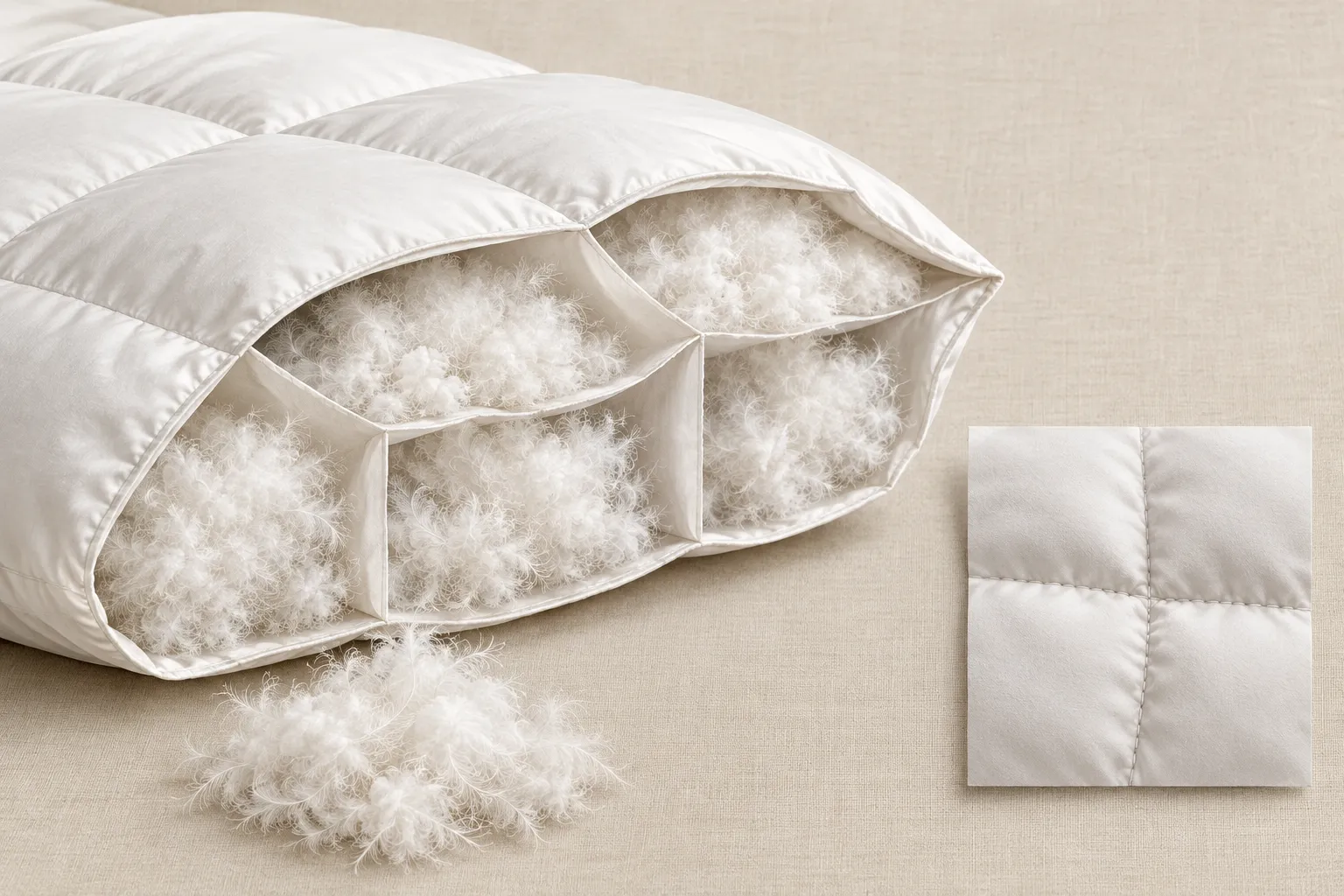
Baffle-box construction puts fabric walls between the top and bottom shell, creating compartments where down can loft. The compartments also keep fill from shifting across the bed. With sewn-through construction, stitches join the two shell layers at the seams. That works for a lightweight comforter, though the fill has less room to loft at each seam.
Construction alone cannot tell you how much down is inside. “Box stitch” could mean internal baffles or a grid sewn through both shell layers, so look for a clear description.
What a certification actually covers
Read the name on the seal. The Responsible Down Standard addresses animal welfare and certified-material chain of custody; OEKO-TEX STANDARD 100 concerns textiles tested for harmful substances. The certified component could be the shell or the finished item. Find out which before assuming the seal covers every part.
How to compare Black Friday and Cyber Monday down bedding deals
The better deal is the comforter whose specs you can read and whose price and return terms work for you. Compare the same size and warmth level first. A large markdown won't make a feather-heavy fill equivalent to one that's mostly down.
If two listings look similar |
Compare this before the sale price |
|---|---|
Both say “goose down” |
Actual down-versus-feather composition |
Both advertise high fill power |
Fill weight and finished dimensions in the same size |
Both show quilted squares |
Baffle-box walls versus sewn-through seams |
Both say “cotton shell” |
Fiber, weave, down-proof details and care instructions |
Both display seals |
Which component is certified and by which standard |
Both promise easy shopping |
Return eligibility, shipping costs and written warranty coverage |
Say you’ve found two queen comforters labeled “luxury goose down.” One gives you its filling mix, fill power, fill weight and baffle construction. The other gives you thread count and a discount. The cheaper listing leaves you unable to compare the filling; ask for the missing specs or buy the one that tells you what’s inside.
Save the listing details for the size and warmth option you chose. Before you order, read whether you can return a used comforter, who pays return postage and what the warranty excludes. A free shipping threshold can change the total too. The countdown on the page won't tell you any of that.
Your pre-checkout checklist
Before you buy goose down bedding during a sale, see how many of these questions the product page and terms answer:
Does the label state the down-versus-feather breakdown and identify the fill?
Can you find fill power and fill weight for your chosen size and warmth?
Does the shell list its fiber, with enough detail to judge its feel and care?
Is the stitching truly baffle box or sewn-through?
Are certification claims specific about what is covered?
Will the dimensions fit your duvet cover and give the drape you want?
Do you understand the return window, any conditions and the warranty exclusions?
If several answers are missing, compare a comforter with clearer details before you commit.
Find a comforter that fits how you sleep
Warmy & Tummy offers goose down comforters with shell options including organic cotton, silk, linen and cooling fabrics, plus choices for different warmth preferences. Its mix-and-match option lets you choose a comforter that suits the way you sleep.
Run your chosen fill and shell through the checklist. Warmy & Tummy describes a 30-day return policy and a 3-year limited warranty; read the current terms and exclusions for the item you select. If its materials and warmth match your bed, that's a better reason to try it than the size of the sale badge.
FAQ
What's the best goose down duvet?
The best one for you states its down content, fill power, fill weight, shell fabric and construction clearly. Choose the warmth for your room and sleep temperature, then compare return terms before buying.
How to wash a goose down duvet?
Follow the care label for your specific comforter, since shell and construction can affect cleaning. Use a duvet cover to reduce how often the insert needs washing, and make sure any washed down is thoroughly dry before putting it back on the bed.
Is goose down good for hot sleepers?
It can be if you choose a lighter warmth level and a shell that feels comfortable in your room. Fill power alone doesn’t tell you whether the finished comforter will sleep cool; consider fill weight and construction too.