

Got $300 for bedding and a comforter that leaves you sweating? Start there when you shop comforter Black Friday deals. If your comforter feels fine but your pillow has gone flat or your sheets feel rough, put the money toward those instead. Keep a duvet cover that still works. The dollar amounts below are planning allowances, not advertised prices.
Black Friday is November 27, 2026; Cyber Monday follows on November 30. Set your ceiling before shopping, with room for tax and shipping. If the comforter you need uses the whole budget, you can leave the rest of the cart empty.
Comforter Black Friday deals: what gets the first dollar?
Spend first on the layer that keeps you awake. Waking up sweaty or cold points to the comforter; an unsupportive pillow deserves attention if your neck feels uncomfortable. Move sheets up the list when they scratch, thin out or slip off the mattress.
A duvet cover is often easiest to postpone. It protects an insert and changes your bed's look, but you can keep one that is still in good shape even if a tempting color goes on sale. A finished comforter may need no cover; a duvet insert does.
Before opening a Black Friday bedding sale, put your needs in this order:
Fix the sleep problem: warmth, support or fabric against your skin.
Replace what is worn out: compressed pillows and fraying sheets take priority over matching colors.
Upgrade the finishing layer: buy a duvet cover when you need one for the insert or your current cover is worn.
Black Friday bedding budget table: $300, $500 or $1,000
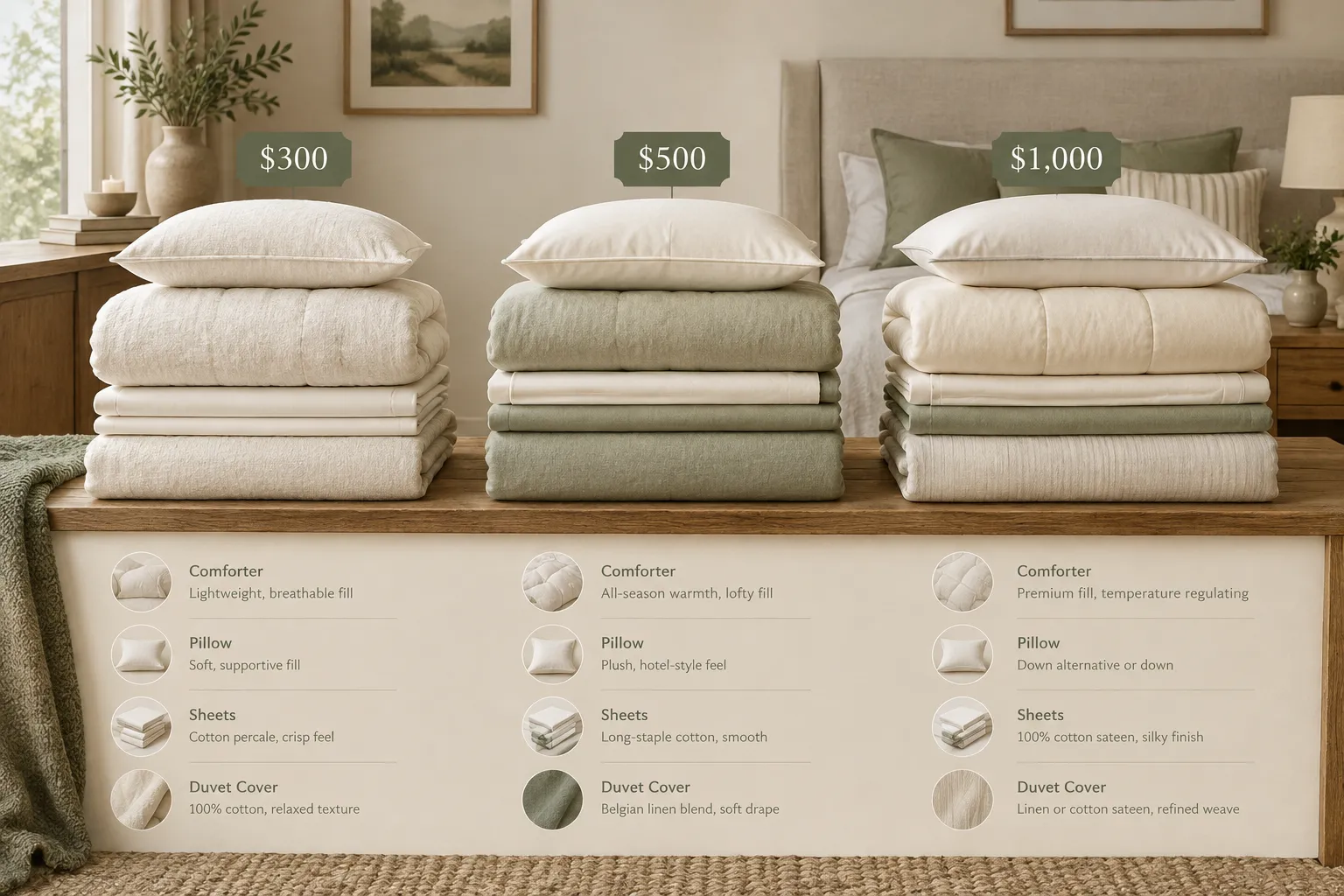
These envelopes are planning amounts, not Warmy & Tummy prices or a promise that every item will fit. Keep the buffer for tax, shipping or a small difference in size or material. If you don't need a replacement in one category, move that money to another item or leave it unspent.
Your preferred shell, size or personalized configuration may not be in a holiday offer. Keep your allowance for the version you want, and compare its final cost with your ceiling. A deal on a different fabric won't help if you don't like sleeping under it.
Planning allowance |
$300 total |
$500 total |
$1,000 total |
|---|---|---|---|
Comforter or duvet insert |
$150 |
$250 |
$500 |
Sleeping pillow(s) |
$50 |
$70 |
$140 |
Sheet set |
$70 |
$110 |
$180 |
Duvet cover |
$0 |
$50 |
$120 |
Tax, shipping or unspent buffer |
$30 |
$20 |
$60 |
Total |
$300 |
$500 |
$1,000 |
At $300, you keep your existing cover or use a finished comforter. The $500 plan leaves room for a modest cover allowance. With $1,000, you can be choosier about materials and replace more layers, but you don't have to spend it all.
If you have $300
Start with a comforter that fixes the temperature problem, then replace the most worn pillow or sheets. Splitting $50 between two sleepers is no saving if neither gets a suitable pillow. If your current comforter works, move its $150 allowance to pillows and sheets.
Buy now vs. wait: Buy a needed comforter or pillow when its size, warmth and final checkout total fit your plan; wait on the duvet cover.
If you have $500
You can replace the core layers and consider a cover if the cart still fits after checkout costs. For a couple, the $70 pillow allowance may cover one replacement, or you can move money from another category. One comfortable pillow is worth more than two that neither person likes.
Buy now vs. wait: Buy the comforter and worn daily-use layers first; wait on the cover if its allowance would force a compromise on warmth, support or fit.
If you have $1,000
With $1,000, you have room to consider a premium shell and fill, plus sheets and pillows suited to your sleep habits. Price alone won't tell you how comfortable the fill will be. If you sleep hot, a lighter warmth level may serve you better than a plush winter option.
Buy now vs. wait: Buy the comforter after settling warmth and material; add the cover only once you know it fits the insert and stays inside the total.
Buy now or wait: comforter, pillows, sheets and duvet cover
Choose what goes in your cart by comfort, wear and fit. A sale banner won't tell you which layer is making nights uncomfortable.
Comforter: prioritize warmth and construction
A comforter shapes how warm you feel under the covers. Pick a warmth level for your room and season, then look at fill, shell fabric, dimensions and care. If you tend to kick the covers off, a lightweight option makes more sense than a winter-weight one.
The temperature in the finding below is measured inside the bed, not on a bedroom thermostat:
"The participants had good sleep quality as long as they could maintain a temperature of 86 to 91 degrees in their bed." - Sleep Foundation, on a quilt-insulation study
Warmy & Tummy has goose down comforters with organic cotton, silk, linen and cooling-fabric shell options, along with mix-and-match choices. You can compare warmth options and dimensions on its organic cotton down comforter page. The choice helps if you know the feel or warmth you're after, though a customized premium comforter may exceed your allowance. If your old insert still feels comfortable and the fill sits evenly, keep it.
Buy now vs. wait: Buy when the warmth, dimensions, care requirements and checkout total suit your bed; wait if the only reason is a discount or you do not know which warmth you need.
Pillows: replace lost support before adding extras
Your pillow needs to keep your head comfortable in your usual sleep position. If it stays lumpy, loses loft or needs constant folding, it may be time for a replacement. Two sleepers may need different pillows, even on the same bed.
Put the pillow allowance toward the one you sleep on. If it won't cover suitable pillows for everyone, replace the worst one first and leave decorative cushions for another time.
Buy now vs. wait: Buy when your current pillow no longer supports you and the replacement suits your sleeping position; wait on spare and decorative pillows.
Sheets: spend for feel and fit, not a number on the label
Sheets touch your skin every night and go through more washes than an insert or cover. Put them first when they pill, fray, feel uncomfortable or won't stay on the mattress. Check fabric, weave and pocket depth; a fitted sheet that pops off is no bargain.
A second set makes wash day easier if you already have good sheets, though a comforter that leaves you cold takes priority. Choose fabric you like against your skin. A high thread count on the label won't tell you how those sheets feel.
Buy now vs. wait: Buy when your sheets are worn or do not fit; wait on a second color if your current set still feels good.
Duvet cover: buy it only when it serves the insert
A cover earns its place if you have an uncovered duvet insert, want an outer layer you can remove, or need to replace a worn cover. Compare dimensions in inches as well as size labels, and look for a closure and attachment points that work with your insert. If you use a finished comforter without a cover, you don't need to add one.
If the cover fabric you want pushes the cart over your cap, keep your existing cover for now. You can choose a new color after you've paid for the layers you need at night.
Buy now vs. wait: Buy when the cover fits and solves a real need; wait if it is only a style refresh and the core layers are still missing.
How to judge a Black Friday bedding sale
A good bedding deal fixes something you notice at night and fits the amount you planned to pay. Compare fill, shell, warmth, size and care across the items on your shortlist. A cheap set with the wrong pillow or a comforter that's too warm may send you shopping again.
“Bedding set” could mean a comforter and shams, a sheet set, or a duvet cover without an insert. Read the contents before comparing a bundle with separate items. If you only need an insert, don't pay extra for pieces you won't use. With down, look at fill type and weight alongside the warmth rating and construction; fill power alone won't tell you how warm the comforter feels.
Before paying, work through this short checkout list:
Write down the bed size, mattress depth, preferred warmth and pillow needs.
Decide which existing layers can stay and assign their allowance elsewhere.
Compare item specifications and the final cart total, including tax and shipping.
Read the return terms for the exact items in the cart, especially personalized ones.
You don't have to shop every category on November 27. If you find a suitable comforter before Black Friday within your ceiling, you needn't wait and risk losing your size. Cyber Monday on November 30 gives you another shopping window, with no guarantee of a lower price on the item you want.
For a broader look at which materials and layers merit a seasonal purchase, see Black Friday Bedding Sale 2026: What Is Worth Buying?.
Make the bed you want to sleep in
Spend first on the layer that's bothering you at night. If you need a comforter, Warmy & Tummy lets you choose among warmth levels, shells and mix-and-match options for your room and preferences. Keep the budget table beside your cart, and don't spend the buffer on a cover you can live without.
FAQ
How long does a bed comforter last?
There is no single replacement date for every comforter. Keep yours while it provides comfortable, even warmth and its shell and fill remain in good condition; replace it when clumping, damage or the wrong warmth level gets in the way of sleep.
How much should I pay for a comforter?
Set a ceiling based on your total bedding budget, not a sale tag. In the sample plans here, the comforter envelopes are $150, $250 and $500 for $300, $500 and $1,000 total budgets; these are planning amounts, not product prices.
Where can I buy a decent comforter?
Look for a seller that describes the fill, shell, warmth, dimensions, care and return terms clearly. Warmy & Tummy offers different shell and warmth choices if you want to tailor a comforter to how you sleep; use your budget ceiling to decide if that choice fits.